토플배경지식
Limestone caves
Caves form in limestone (calcium carbonate), and occasionally in dolomite (calcium magnesium carbonate), when water containing dissolved carbon dioxide (carbonic acid) seeps into rock crevices and joints. The carbon dioxide comes from decaying organic matter in soil, and also directly from the atmosphere. This slightly acidic water dissolves the rock, forming cavities which can enlarge and join up to make larger cave systems of interconnected chambers. An underground water flow can develop when many rain-fed subsurface drainages join up, or a river can be captured by an open cavity collapse structure (sink hole or doline) and flow underground. This leads to further enlarging and sculpturing of the caves by chemical and physical weathering. Gravel, sand, silt and clay can be deposited in the caves from outside, or fine sediments from internal springs may build up. This dissected and dissolved landform with a complex groundwater system is called karst.
Top
Cave decorations
Southern entrance to Devil's Coach House, Jenolan Caves, New South Wales. Photo: R Pogson © Australian Museum.
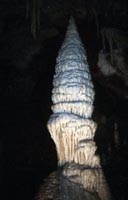
'The Grand Minarette', River Cave, Jenolan Caves, New South Wales. Photo: R Pogson © Australian Museum.
'The Shrine', showing stalactites, stalagmites and columns, Ribbon Cave, Jenolan Caves, New South Wales. Photo: R Pogson © Australian Museum.
'The Fluted Column', Imperial Cave, Jenolan Caves, New South Wales. Photo: R Pogson © Australian Museum.
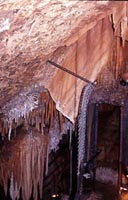
Shawls, stalactites and helictites, Ribbon Cave, Jenolan Caves, New South Wales. Photo: R Pogson © Australian Museum.
Calcite anthodites with calcite and aragonite helictites, 'Lyre Bird's Nest', Ribbon Cave, Jenolan Caves, New South Wales. Photo: R Pogson © Australian Museum. When underground rivers work deeper, or water-filled cavities are drained, the resulting free spaces (often the higher or older chambers) can be decorated with various types of crystalline calcium carbonate formations.
After passing through limestone, the acidic water contains calcium carbonate in soluble form, now present in solution as calcium bicarbonate. When the solution loses carbon dioxide, it deposits solid calcium carbonate again. The resulting mineral is usually calcite, but occasionally a calcium carbonate with different crystal form can grow (aragonite). The solution can lose carbon dioxide when degassing through direct exposure to air, especially when it splashes, or flows over impediments. The resulting cave formations have a waxy, glistening appearance. Loss of carbon dioxide through evaporation plays a much lesser role, usually in areas of high airflow near cave entrances, but the resulting cave formation usually look dull and chalky. Bacterial and algal colonies can also play a role in deposition of calcium carbonate. Cave deposits or decorations are called speleothems.
How a cave is decorated depends on whether the water drips, seeps, flows or sits in pools.
Dripstones
Straws grow from hanging drops of water. The crystals form on the outer rim of each successive drop, building up a hollow tube with internal diameter of a few millimetres. Straws sometimes reach lengths of over 6 metres.
Stalactites grow from water dripping off a cave roof. A long, thin hollow tube, a straw, forms first, but its internal channel becomes blocked, forcing water to flow over its outer surface, depositing successive layers of calcite, resulting in a stalactite with typical pointed carrot shape.
Stalagmites grow from splashing drips beneath the stalactites. Stalagmite shapes tend to be 'stumpy' or rounded, compared to the more pointed shape of stalactites.
Columns result when a stalactite and its corresponding stalagmite meet.
Shawls grow from water trickling down sloping surfaces. Layers of calcite build up into fluted curtains.
Seepstones
Helictites seem to defy gravity. They grow when water slowly seeps through porous roof or wall surfaces, producing tiny droplets that precipitate calcite in the form of fine tubes with minute internal channels. The water flows through the tubes by capillary action, and changes in the direction of growth may be due to blockages in the internal channels. As the calcite grows from the tip at various angles, interesting twisted shapes result.
Flowstones
Flowstone forms from layers of calcite deposited when thin films of water flow down walls and across cave floors. Some resemble 'frozen waterfalls'.
Flowstone often forms over gravel and silt left behind by underground rivers. When this material is washed away to leave an undercut, canopies of flowstone are left unsupported.
Rimstone dams build up on slopes as slow-moving water flows over them. Bumps on the sloping surface promote turbulence and assist carbon dioxide loss. The resulting low walls can hold back water to form a pond.
Poolstones
Rafts are formed from thin skins of crystalline calcite which float on the surface of a pool.
Calcite crystals grow as 'dog-tooth spar' when caves or smaller cavities are filled with still water. These solutions are saturated with dissolved calcium carbonate and can precipitate crystals with perfect geometrical shapes. They stop growing when the water drains out.
Calcite can crystallise as a very thin and fragile shell around air bubbles, which will eventually sink to the bottom of the pool.
Cave pearls are formed when calcite grows around small grains in a pond, adding layer after layer to form small spheres
(출처):
http://www.amonline.net.au/geoscience/earth/caves.htm
|





 > board
 작성일 : 07-06-22 00:57


 조회 : 3,073
  추천 : 0


 Total 1,375