토플배경지식
History
In the history of clocks and time-keeping, one of the earliest clocks was driven by water; the Roman 'horologium'. This term was later applied to the earliest mechanical clocks. The first mechanical clocks only indicated time by sounding a bell each hour. This kind of 'horloge' became called a 'clocca', from the Latin for 'bell'. By the 14th century, this had evolved to 'clocke' in English. Once the mechanism was developed to indicate the time visually, this new part was called the 'watch', taking its name from the parts of a day as used to manage sentries and sailors. If a timepiece struck the hours and showed the time, it was thus called a 'clock-watch'. Most early mechanical clocks were driven by the fall of weights. The technological development which made the first reliable mechanical clock was the verge escapement, invented in about 1275. The escapement controls the flow of power to the rest of the movement; without it the clock would keep time poorly. Wheels of different sizes and patterns of notches or pins make up the train; this rotates the hands at different speeds and strikes the hours and quarters. Early clocks were large and expensive and were usually only on churches and other public buildings. Domestic clocks began to appear in British houses in about 1600. These early clocks, called 'chamber clocks', were of the 'lantern' type. The name 'lantern' may come from their appearance, or else is a corruption of the word 'latten', meaning brass. They were hung from a hook on the wall and weights hung down below them on ropes, later chains. There were up to three weights - for the time, the striking and sometimes also an alarm. They had no pendulum, which was not invented until 1658. A bell on top was struck to indicate the hours. Most had an hour hand only, with markings on the dial for hours and quarters. The earliest had to be nine feet off the ground and would run for just 12 hours. Later models ran for one day or perhaps 30 hours. The first clocks were made of iron; later brass became the preferred metal, often with thickly gilded dials.
Movements
The movement consists of a system of brass and steel wheels and gears, known as the train. It's usually housed between two brass plates.
The escapement. This is the part of the movement that controls the speed at which a clock runs.
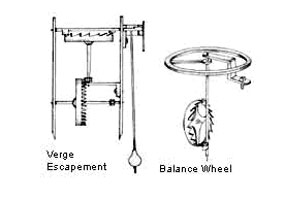
The verge or balance wheel escapement. The balance wheel escapement was used on lantern clocks until c.1760. The oscillating balance wheel releases the two pallets of 'flags' on the vertical bar, which engage the toothed wheel. The verge escapement is similar but has a short pendulum.
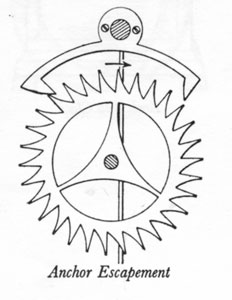
The anchor escapement. This was first used in long-cases from c.1670, and became standard for long-cases and brackets. The anchor engages with the teeth of the escape wheel. Clocks with an anchor may have a long or short pendulum.
The anchor escapement is what we use in the movements on our Longcase / Grandfather clocks today.
Pendulums
Weight-driven and spring-driven clocks usually have a pendulum to control the clock's speed. The pendulum is a brass or steel rod with a metal disc, or bob, at the bottom. Adjusting the position of the bob on the rod alters the timekeeping of the clock.
Dials
A. Chapter ring B. Subsidiary dial C. Calendar aperture D. Applied corner spandrels E. Winding holes F. Hour hand G. Minute hand H. Dial arch I. Engraved boss J. matted or engraved centre
Brass dials. These are the earliest type of dial, used on lantern, bracket and long-case clocks. These have the hours engraved onto a detachable chapter ring.
Painted metal dials. These are found on most clocks after c.1800. They became increasingly elaborate in the 19th century.
Painted wooden dials. These are found on English dial clocks, tavern clocks and continental clocks. If authentic, the wood will show some signs of cracking caused by changes in temperature.
Enamelled metal dials. These are common on carriage clocks and other types of French clock. They're made from enamel fired on top of thin copper.
Hands
Early clocks only have one hand (for hours), but from c.1660 most have both a minute and an hour hand. Second hands are usually shown on a subsidiary dial. Hands are usually made from blued steel, although gilded brass is found from c.1790. Until c.1740 the hour hand was elaborate, while the minute hand was longer and simpler.
Cases
The case houses the dial and the movement. Knowledge of materials and styles is useful in dating a clock and in assessing its value.
Wooden cases. These were introduced in the 17th century. Many cases are covered with thin veneers of wood. The most common woods are oak, walnut, mahogany, ebony and rosewood. Wooden cases may be decorated with marquetry (patterns made from different woods), lacquer, applied metal mounts, brass inlay (on rosewood cases), or a combination of tortoiseshell and brass (boulle work).
Metal cases. Brass is the most common metal: all carriage clocks are brass-cased. Old brass is uneven and shows marks left by the casting process, while modern rolled brass is of uniform thickness. Brass cases may be elaborately engraved or decorated with enamel colours.
Longcase clocks
Longcases, popularly known as grandfather clocks, are among the most appealing of all antique clocks. Most were made in England between the late 17th and 19th centuries, although lesser numbers were also produced in Europe and America. The standard longcase runs for eight days and has an anchor escapement
The style of clock called the 'longcase clock' became known as a 'grandfather clock' only in the Victorian era when an American, Henry Clay Work, published a song in 1876.
http://www.marklavertonclocks.com/history.html
|





 > board
 작성일 : 07-06-22 01:11


 조회 : 3,001
  추천 : 0


 Total 1,375