토플배경지식
Urban heat island
From Wikipedia, the free encyclopedia
Causes
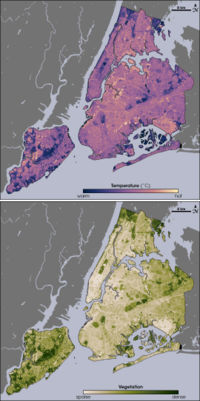
Thermal (top) and vegetation (bottom) infrared satellite data measured by NASA’s Landsat 7 Enhanced Thematic Mapper Plus on August 14, 2002, one of the hottest days in New York City's summer. A comparison of the images shows that where vegetation is dense, temperatures are cooler.There are several causes of a UHI, as outlined in Oke (1982). The principal reason for the night-time warming is (comparatively warm) buildings blocking the view to the (relatively cold) night sky. (See Thermal radiation) Two other reasons that UHIs occur are changes in the thermal properties of surface materials and lack of evapotranspiration in urban areas. Materials commonly used in urban areas, such as concrete and asphalt, have significantly different thermal bulk properties (including heat capacity and thermal conductivity) and surface radiative properties (albedo and emissivity) than the surrounding rural areas. This initiates a change in the energy balance of the urban area, often causing it to reach higher temperatures (measured both on the surface and in the air) than its surroundings. The energy balance is also affected by the lack of vegetation and standing water in urban areas, which inhibits cooling by evapotranspiration.
Other causes of a UHI are due to geometric effects. The tall buildings within many urban areas provide multiple surfaces for the reflection and absorption of sunlight, increasing the efficiency with which urban areas are heated. This is called the "canyon effect". Another effect of buildings is the blocking of wind, which also inhibits cooling by convection.
Some causes of a UHI are anthropogenic, though they are relatively minor in summer and generally in low- and mid-latitude areas. In winter and especially in high latitudes, when solar radiation is considerably smaller, these effects can contribute the majority of UHI. As urban areas are often inhabited by large numbers of people, heat generation by human activity also contributes to the UHI. Such activities include the operation of automobiles, air conditioning units, and various forms of industry. High levels of pollution in urban areas can also increase the UHI, as many forms of pollution can create a local greenhouse effect.
Different climatic regions may have very different experiences of UHIs. In an already warm area they will be unwelcome; in a cold area they might be beneficial.
The EPA discusses one of the reasons when it says:
Heat islands form as vegetation is replaced by asphalt and concrete for roads, buildings, and other structures necessary to accommodate growing populations. These surfaces absorb - rather than reflect - the sun's heat, causing surface temperatures and overall ambient temperatures to rise.
The lesser-used term heat island refers to any area, populated or not, which is consistently hotter than the surrounding area.
Some cities exhibit a heat island effect, largest at night (see below), and particularly in summer,[4] or perhaps in winter,[5] with several degrees between the center of the city and surrounding fields. The difference in temperature between an inner city and its surrounding suburbs is frequently mentioned in weather reports: e.g., "68 degrees downtown, 64 in the suburbs."
[edit] Significance
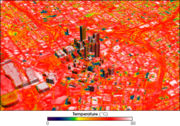
Thermal image of Atlanta, Georgia, blue shows cool temperatures, red warm, and hot areas appear white. Daytime air temperatures were only about 26.7°C (80°F), but some surface temperatures reached 47.8°Celsius (118°F).Urban heat islands are of interest primarily because they affect so many people. According to estimates by the United Nations, nearly half of the world's population currently live in urban areas. Within western nations, this number can approach 75%. The impact of UHIs on the world's populace has the potential to be large and far-reaching.
UHIs have the potential to directly influence the health and welfare of urban residents. Within the United States alone, an average of 1000 people die each year due to extreme heat, more than due to all other weather events combined (Changnon et al., 1996). As UHIs are characterized by increased temperature, they can potentially increase the magnitude and duration of heat waves within cities. Research has found that the mortality rate during a heat wave increases exponentially with the maximum temperature (Buechley et al., 1972), an effect that is exacerbated by the UHI. The nighttime effect of UHIs (discussed below) can be particularly harmful during a heat wave, as it deprives urban residents of the cool relief found in rural areas during the night (Clarke, 1972).
Research in the United States suggests that the relationship between extreme temperature and mortality in the U.S. varies by location. According to the Program on Health Effects of Global Environmental Change at Johns Hopkins University (JHU), heat is most likely to increase the risk of mortality in cities at mid-latitudes and high latitudes with significant annual temperature variation. For example, when Chicago and New York experience unusually hot summertime temperatures, elevated levels of illness and death are predicted. In contrast, parts of the country that are mild to hot year-round have a lower public health risk from excessive heat. JHU research shows that residents of southern cities, such as Miami, tend to be acclimated to hot weather conditions and therefore less vulnerable.
Another consequence of urban heat islands is the increased energy required for air conditioning and refrigeration in cities that are in comparatively hot climates. The Heat Island Group estimates that the heat island effect costs Los Angeles about $100 million per year in energy. Conversely, those that are in cold climates such as Chicago would presumably need somewhat less in the way of heating.
Aside from the obvious effect on temperature, UHIs can produce secondary effects on local meteorology, including the altering of local wind patterns, the development of clouds and fog, the number of lightning strikes, and the rates of precipitation.
Using satellite images, researchers discovered that city climates have a noticeable influence on plant growing seasons up to 10 kilometers (6 miles) away from a city’s edges. Growing seasons in 70 cities in eastern North America were about 15 days longer in urban areas compared to rural areas outside of a city’s influence.[6][7]
출처 http://en.wikipedia.org/wiki/Urban_heat_island
|





 > board
 작성일 : 07-06-23 18:31


 조회 : 3,768
  추천 : 0


 Total 1,375